How to Plan a Football Matchday While Travelling
Plan a football matchday while travelling with practical guidance on fixture checks, tickets, stadium transport, entry, accommodation and getting home.

Football Finder Team
· 12 min read

The most stressful football trips rarely go wrong because someone forgets the kickoff time.
They go wrong because the plan ends at the stadium gates.
The outward train has been checked, but the return service has not. The ticket sits in an account that cannot be opened without mobile data. The group arrives near the stadium with time to spare, only to discover that its entrance is on the opposite side of the ground.
At home these details are easier to manage, because the transport network, the neighbourhood and the matchday routine are already familiar. In another city, in other language, every ordinary decision takes slightly longer.
A dependable matchday plan therefore covers more than the match itself. It begins with a confirmed fixture and it ends when the supporter has a realistic way to reach the hotel, the station or the next destination after full time.
The objective is not to schedule every minute. It is to remove avoidable pressure, so the day still works when a train is delayed, a queue moves slowly or the correct entrance takes longer to find.
This guide starts after the match has been chosen. If you are still deciding which fixture to build the trip around, start with how to find football matches while travelling and come back here once the ticket is secured.
If you are still arranging the wider trip around the fixture, use our complete football tourism guide first.
How do you plan a football matchday while travelling?
To plan a football matchday while travelling, confirm the final fixture, stadium and ticket before building the day. Use the Football Finder World Map to understand where the venue actually sits, plan the outward and return journeys separately, prepare mobile entry before you leave the accommodation, check the stadium's own entry rules, and leave enough time for queues, food and finding the correct entrance.
What should a football matchday plan include?
Stage | What to confirm |
Fixture | Final date, local kickoff time, home team, opponent and competition |
Stadium | Exact venue, district, nearest station and correct entrance |
Ticket | Official purchase route, delivery method, account access and identification rules |
Outward journey | Route, changes, walking time and a backup option |
Arrival | Food, meeting points, queues, security and finding the seat |
Entry | Bag limits, prohibited items and mobile-ticket instructions |
Full time | Crowd controls, final services and alternative transport |
Accommodation | Whether the outward and return journeys work from the chosen area |
A good plan stays workable when one stage takes longer than expected.
Should you reconfirm the fixture before you travel?
Yes, and more than once. Treat any fixture listing as the start of the process rather than the final word.
Check the club and the competition before booking anything non-refundable, again after buying the ticket, and again shortly before departure. Broadcasters move kickoffs, cup rounds land late, and a Saturday afternoon can become a Sunday evening after the trains you booked have already been paid for.
For example, for a Dortmund trip that means comparing the listed fixture against Borussia Dortmund's schedule and the Bundesliga fixture list. The club and the competition remain the final authorities on date, time and venue.
How should you research football tickets before travelling?
Begin with the official club ticket office, and expect it to have conditions: membership, a ballot, purchase history, an official resale platform, or a narrow general sale. Confirm how the ticket is delivered, and whether the name, account or identification has to match the person walking through the turnstile.
Club | Official club ticket page | Third-party ticket comparison |
Borussia Dortmund | ||
Bayern Munich |
Affiliate disclosure: the ticket-comparison links above are affiliate links to a third-party provider. Football Finder does not sell, issue, transfer or guarantee tickets.
Before paying through any third party, look at the seller, the seat details, the delivery method, the transfer procedure, the identification conditions and what happens if the match is rescheduled. Our ticket guidance sets out the checks travelling supporters should make, club by club.
How do you get from the city centre to the stadium?
Do not rely on the distance a general city search shows you.
Identify the exact stadium, the district it sits in, the nearest practical station and the final walk. Then test that route at the time you will actually travel, rather than at a quiet weekday hour.
When several grounds are available, it can help to find football matches across a city before committing to one journey.
Example: How do you get to Signal Iduna Park from Dortmund Hauptbahnhof?
Signal Iduna Park (Westfalenstadion) holds 81,365 and sits south of Dortmund city centre, a short ride from the main station.
Borussia Dortmund recommend arriving by public transport, fan bus, bicycle or on foot. From Dortmund Hauptbahnhof there are two straightforward options: a regional train to SIGNAL IDUNA PARK station, which sits alongside the ground, or the light rail towards Westfalenhalle and Stadion. The club names the U45 (Fredenbaum – Hauptbahnhof – Westfalenhallen) as the main line towards the stadium, with the U42 and U46 also serving the area.
Two details are worth knowing before you travel:
A Dortmund season ticket doubles as a travel ticket across North Rhine-Westphalia on matchday, valid until 3:00 the following morning. A print-at-home or digital match ticket does not, you need a separate transport ticket.
The club warns explicitly that platform and vehicle capacity at SIGNAL IDUNA PARK station is limited after the final whistle, and asks supporters to be patient leaving the ground.
The route should never end with "take the train to the stadium". It should name the service, the station, the final walk and the way back.
What time should you leave for a football match?
There is no universal arrival time that works for every stadium and every fixture.
A small ground with simple entry needs less preparation than an unfamiliar 80,000-seat venue. A high-demand match, a strict mobile-ticket process or a major transport restriction needs considerably more.
Work backwards from the time you want to be inside:
Planning component | Time to account for |
Final walk from the station | Use the stadium-specific walking time, not a city-centre estimate |
Finding the correct side of the ground | Add time whenever the entrance is unfamiliar |
Ticket or identification checks | Follow the club's published entry guidance |
Security and turnstile queues | Increase the allowance for major fixtures |
Food or meeting other supporters | Finish this before approaching the entrance |
Transport delay buffer | Add a realistic margin rather than trusting one service |
For an unfamiliar major stadium, reaching the wider stadium district around two hours before kickoff is a practical starting point, but it is a starting point, not a rule. The final decision should follow the venue's own guidance, gate-opening times, ticket instructions and the complexity of your route.
Some clubs publish that number outright. LAFC, for example, strongly recommend arriving at BMO Stadium two hours before kickoff, because traffic and parking queues build sharply closer to the match. That is a venue-specific instruction rather than a universal football standard.
The point is consistency. Do not tell yourself 60 minutes is enough when the journey, the beer, the walk, security and the search for the right entrance could reasonably take three times that.

Why should you plan the return journey before kickoff?
Because the matchday ends when you reach the hotel, the station or the next destination, not when the referee blows the final whistle.
Plan the outward and return journeys separately, because they run under different conditions. After the match, account for:
Reduced evening service
Crowded platforms
Road closures and temporary pedestrian routes
Limited taxi or ride-share access
The last train, and what happens if you miss it
Extra time and penalties
The time it takes simply to leave the stand
Whether a different station offers a better route out
Borussia Dortmund's own advice is a good illustration: capacity at SIGNAL IDUNA PARK station and on public transport is limited after matches, and supporters are asked to allow plenty of time.
A direct outward route does not guarantee a simple journey home. Save a backup, identify a second useful station, and avoid any itinerary that depends on catching one final service with no margin.
Where should you spend the hours before kickoff?
Choose the pre-match area before matchday, not on the day.
Some supporters prefer the stadium neighbourhood. Others do better eating in the city centre and travelling out later. The right answer depends on opening times, reservations, crowd levels and how long it takes to reach the entrance from wherever you have chosen to sit.
Eating earlier than usual is one of the cheapest ways to keep a relaxed plan from becoming a rushed one. Finish the meal before the point where a single delay would threaten stadium entry, and check the venue's opening hours and matchday conditions rather than building the day around a pub that turns out to be full, closed or unsuitable for the group.
How do mobile football tickets work?
A mobile football ticket often needs more than a screenshot.
The ticket may live inside a club app, an online account, a digital wallet or a time-limited link. Some systems block screenshots, refresh the barcode every few seconds, or require a formal transfer to another account before a second person can use it.
Before leaving the accommodation:
Open the ticket using the method the club requires.
Confirm the correct match and seat are visible.
Complete any required transfer.
Download the club app and sign in.
Add the ticket to the permitted digital wallet where that is available.
Charge the phone and carry a power bank — subject to the rules below.
Save booking references and support contacts somewhere separate.
Mobile networks become unreliable around major venues, and clubs know it. Borussia Dortmund warn that networks in the event area often collapse well before kickoff during large events, which can leave supporters unable to log in at exactly the moment they need to.
Do not assume a screenshot will be accepted unless the club explicitly says so.
What can you take into a football stadium?
Check the official rules for the specific stadium, every time.
Bag sizes, prohibited items, cameras, food, drink, flags, power banks and identification requirements differ between venues. The rules for one club should never be applied to another. Review:
Maximum bag dimensions
Luggage restrictions
Prohibited items
Camera rules
Identification requirements
Accessibility procedures
Your designated entrance
Cashless payment requirements
Re-entry policy
Large luggage should normally stay at the hotel or in a proper storage facility. Do not travel to a stadium assuming lockers or bag storage will be available — at most grounds they are not.

Can you take a power bank into a football stadium?
Usually yes — but the bag you were planning to carry it in is the more likely problem.
A travelling supporter's phone does far more work than it does at home. It holds the ticket, the map, the transport app and the camera, and it spends the afternoon hunting for signal in a crowd. A phone that comfortably lasts a day in your own city can be at 15% by kickoff somewhere unfamiliar, which is a genuinely bad position when the ticket lives inside an app.
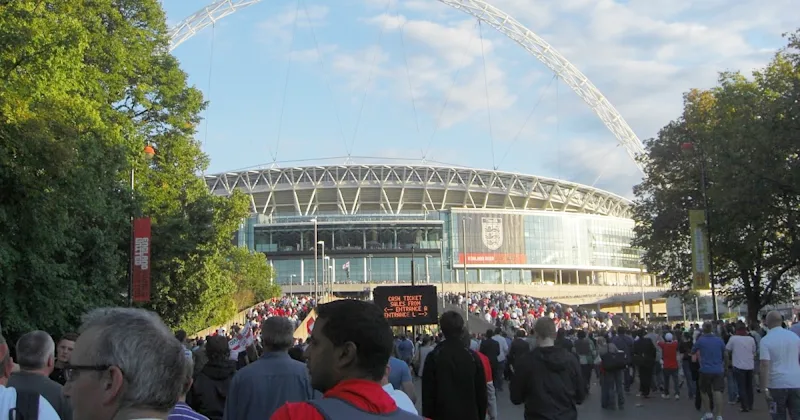
The complication is that stadiums regulate the container, not the charger. For example, Signal Iduna Park's regulations prohibit suitcases, bags and rucksacks altogether, so anything you bring to a Dortmund match has to fit in a pocket. English grounds tend to go the other way and cap the bag instead: Wembley and London Stadium allow nothing larger than A4, and Old Trafford is tighter still at roughly 20 × 15 × 5cm.
That points at one practical answer for travel:
Pocket-sized beats high-capacity.
Something around 10,000mAh will refill most phones twice and still fit in a jacket pocket. A large brick may be refused simply because it cannot go anywhere permitted.
One per person.
Most venues that allow power banks allow a single personal unit.
Check the specific ground first.
Policies differ between clubs in the same league, and a rule you followed last season may have changed. The stadium's own prohibited-items page is the only authority worth trusting.
Carry the cable too.
Plenty of supporters arrive with a charged pack and no way to connect it.
If you are travelling without one, a compact 10,000mAh power bank covers a full matchday including navigation and photographs.
Affiliate disclosure: as an Amazon Associate, Football Finder earns from qualifying purchases. This does not affect the price you pay.
Should you stay near the stadium or in the city centre?
Compare the complete trip, not the stadium alone.
Stay near the stadium when | Stay in the city centre when |
The match finishes late | Sightseeing is a major part of the trip |
Return services are limited | The stadium has a direct public-transport connection |
Football is the main purpose of the trip | Several possible matches are being compared |
The group wants a shorter post-match journey | The onward train or airport route starts centrally |
Early stadium activity is planned | The centre offers stronger dining and transport options |
How should matchday planning change in the United States or Canada?
Start with the exact soccer stadium rather than the club's city label. The venue may sit on a rail line, need a transfer from the centre, or sit inside a larger exhibition or sports district with its own crowd flow.
What should you do before you leave for the match?
A successful matchday plan connects the fixture, the ticket, the stadium, the transport, the entry process and the accommodation.
Confirm the match before making non-refundable arrangements.
Research the official ticket route before building a trip around a club.
Understand the stadium's exact location and the final walk.
Plan the outward and return journeys as two separate problems.
Prepare the mobile ticket before you leave the hotel.
The Football Finder World Map places a fixture in its geographic context, while our stadium, city and nearby pages take you to the next level of practical detail. If you are still choosing, see what is on this weekend or near you right now.
The Football Finder mobile apps can also support match discovery during the trip:
Find the match first, then build the matchday around it.
Frequently Asked Questions
How do you prepare a mobile football ticket before matchday?
Open the ticket through the method the club requires, complete any formal transfer and add it to the permitted wallet or app. Sign in before leaving the hotel, charge the phone and keep the booking reference somewhere separate. Do not rely on a screenshot unless the club confirms screenshots are accepted.
Should you print a football ticket?
Print the ticket only when the club provides a print-at-home version or recommends carrying a paper copy. Some venues accept mobile tickets only, while others issue printable PDFs. Printing an unsupported screenshot or barcode does not guarantee entry.
What can you take into a football stadium?
Check the stadium's official bag and prohibited-items policy. Restrictions may cover bag dimensions, cameras, bottles, food, flags, power banks and other objects. Rules differ between venues, so guidance from a previous match should not be reused without verification.
Can you take a power bank into a football stadium?
Most stadiums allow one personal power bank, but the bag it travels in is the more common obstacle. Signal Iduna Park prohibits bags and rucksacks entirely, so a charger has to fit in a pocket, while Wembley and London Stadium cap bags at A4 size. Choose a pocket-sized unit of around 10,000mAh and check the specific ground's prohibited-items page before travelling.
Can you take luggage to a football match?
Large luggage is often restricted, and stadium storage may not be available. Leave luggage at the hotel or arrange storage before travelling to the ground. This matters most when the match falls between hotel checkout and an onward train or flight.
Is it better to stay near the stadium or in the city centre?
It depends on the complete itinerary. Staying near the ground suits a late finish or limited transport. Central accommodation works better when the match is one part of a wider trip. Compare the return journey, sightseeing plans and onward travel before booking.
What should you do if mobile data fails near the stadium?
Prepare the ticket before leaving the accommodation, add it to the approved wallet where possible and stay signed into the required app. Save the booking reference and support details separately. Clubs including Borussia Dortmund warn that networks in the stadium area can collapse well before kickoff.
How do you check whether a football fixture has changed?
Check the official club and competition before booking non-refundable travel, after purchasing the ticket, and again shortly before departure. Confirm the date, local kickoff time, home team, stadium and whether the ticket remains valid after any change.
How long before kickoff should you arrive at a football stadium?
There is no single answer. Follow the venue's own guidance: LAFC strongly recommend two hours before kickoff at BMO Stadium, while a smaller ground with simple entry may need far less. Work backwards from the time you want to be inside, allowing for the walk, queues, food and finding the correct entrance.
How does the Football Finder World Map help with matchday planning?
The Football Finder World Map shows fixtures geographically. It helps supporters understand a stadium's relationship to the hotel, station, airport or onward route, compare nearby alternatives, and decide whether the complete matchday is practical.